


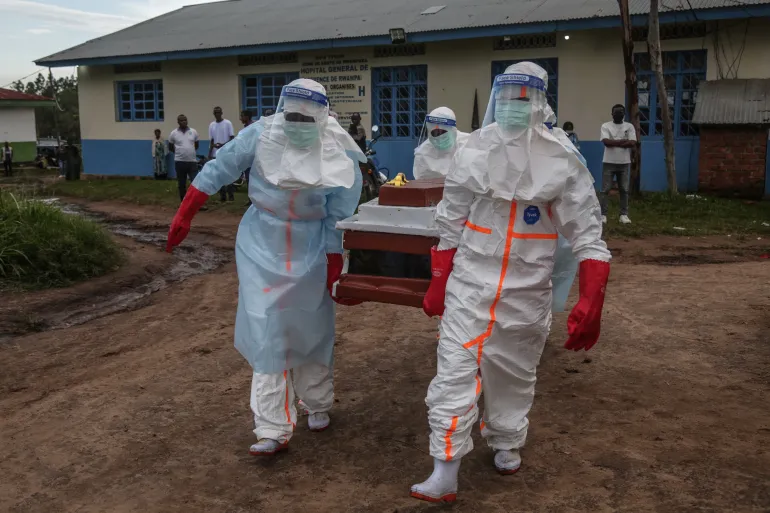
How geography is shaping Congo’s Ebola response
In Kinshasa, life is moving on. Markets are busy, transport is running, and the city’s usual energy has not given way to panic, even as Ebola continues to raise concern in other parts of the Democratic Republic of Congo.
That calm is not a sign that people do not care. It reflects something more practical: distance. The outbreak is unfolding far from the capital, and that geography is shaping how people in Kinshasa experience the news, how officials respond, and how the rest of the world reacts.
Distance changes perception
Outbreaks often feel different depending on where people are standing. In the eastern part of Congo, Ebola is a direct public-health threat that demands urgent contact tracing, isolation, and medical response. In Kinshasa, by contrast, the disease can feel distant, almost abstract, even though it remains serious for the country as a whole.
That gap matters. When a crisis is far away, daily routines continue. People still go to work, shop, travel, and use public transport. The outbreak becomes something they hear about rather than something they see in front of them.
Why the capital stays calm
Kinshasa is a huge, fast-moving city where people are used to coping with uncertainty. That can make it less likely to freeze in response to a crisis happening hundreds of miles away.
There is also a psychological factor. Ebola is feared worldwide, but people are more likely to treat it as an immediate danger when it is nearby, visible, or affecting someone they know. If the outbreak is elsewhere, many residents will wait and watch instead of changing their lives right away.
That does not mean the threat is ignored. It means the response is filtered through distance, routine, and local experience.
The global reaction is different
Outside Congo, the response is usually much more cautious. Ebola triggers memories of past outbreaks, border restrictions, quarantine measures, and public-health alarms.
That is why international reactions can look much stronger than the mood inside the capital. Governments and health agencies are more likely to focus on containment, travel screening, and limiting exposure. For them, the priority is preventing a regional outbreak from becoming a wider one.
A related report says the U.S. has already taken precautionary steps involving Congo’s soccer team and travel restrictions, showing how quickly an outbreak can affect movement and diplomacy beyond the health sector.
What this means for ordinary people
For most people in Kinshasa, the outbreak may not change the day-to-day rhythm of life immediately. But it can still have indirect effects.
Travel may become more complicated. Families with relatives in affected areas may worry more. Businesses can feel the effect if transport slows, trade becomes more cautious, or people start avoiding certain routes and services.
There is also a stigma risk. During outbreaks, people from affected regions can be treated with suspicion even if they are healthy. That can create social tension long after the medical emergency is under control.
The economic angle
Even when a city appears calm, outbreaks can still create financial uncertainty. Investors and companies tend to dislike anything that could disrupt movement, supply chains, or consumer confidence.
If the outbreak stays localized, the economic damage may remain limited. But if fear spreads faster than the virus, the consequences can widen quickly through reduced travel, tighter screening, and lower willingness to do business.
This is one reason health crises are never only health crises. They affect confidence, and confidence affects everything from tourism to logistics.
Best-case and worst-case paths
The best-case scenario is that the outbreak remains contained in the east, public-health teams act quickly, and the capital continues largely as normal. In that case, Kinshasa’s relative calm would look like a rational response to a distant crisis.
The worst-case scenario is that the outbreak grows, fear spreads, and outside governments tighten restrictions further. That would turn a geographically distant problem into a national and international one, with wider effects on travel, trade, and public trust.
Simple terms
Ebola is a serious viral disease that spreads through direct contact with infected bodily fluids.
Containment means stopping it from spreading beyond the current outbreak area.
Isolation means separating people who may have been exposed so they can be monitored safely.
Contact tracing means finding people who may have been near an infected person and checking whether they need care.
Bottom line
The real story is not just that Congo has an Ebola outbreak. It is that geography is shaping how people respond to it. The farther the outbreak is from everyday life in Kinshasa, the less immediate it feels, even though the national and global stakes remain high.
That contrast between local calm and wider alarm is what makes the situation worth watching.
